
Grant County Court Record Requests
Use WCCA online to identify a public circuit case, confirm Grant County, and capture the case number. For the complete file, contact the Grant County Clerk of Circuit Court at 130 W. Maple Street, P.O. Box 110, Lancaster, WI 53813. The office lists (608) 723-2752 and weekday public hours of 8:00 a.m. to 4:30 p.m. Confirm current hours and delivery methods before visiting or mailing a request.
Every documented route has a role. WCCA is the online finding aid. The clerk counter supports inspection and copies. Telephone contact helps confirm custody, current fees, and a mailed request process. Mail can carry a written, narrow request after the office confirms payment and return requirements. Grant County NextRequest handles general county-government records, but it is not the court docket or the default circuit-file channel.
- Find the case number in WCCA or ask the custodian to identify the file.
- Name the exact event, filing, order, judgment, or date range needed.
- Choose online review, counter inspection, telephone coordination, or a mailed request.
- Ask for a current fee estimate and payment instructions.
- Confirm whether an ordinary copy, certified copy, transcript, or electronic reproduction is required.
WCCA Versus Grant Court Files
Wisconsin Circuit Court Access is the official public starting point for circuit case information. It may show a case summary and chronological history with parties, type, status, hearings, entries, orders, dispositions, and financial events that are open to public view. Search by exact case number when possible, or by name with available filters.
WCCA is not the complete clerk file. It generally does not offer every pleading, exhibit, signed order, transcript, or document image. A public summary can locate the file and identify the item to request. When the wording of an order matters, rely on the official copy rather than a short event label. A no-result search may reflect a restricted, sealed, juvenile, new, archived, or differently indexed matter.
Kinds of Court Records
The Grant County Clerk of Circuit Court maintains circuit civil, criminal, traffic and forfeiture, family, small-claims, judgment, lien, and records of court proceedings. The file type controls what may be public and which documents exist. Passport service is another clerk-office function, but it is not a court-record category.
- Case summaries and chronological docket histories
- Pleadings, motions, notices, orders, and judgments in the court file
- Criminal, traffic, forfeiture, civil, family, and small-claims records
- Judgment and lien information maintained by the clerk
- Records of proceedings and separately ordered court-reporter transcripts
Grant Court Record Custodians
Most circuit matters go to the Grant County Clerk of Circuit Court. Probate, guardianship, mental-health, and juvenile proceeding administration routes to the Register in Probate. That separate office structure matters because ordinary WCCA display may not show a complete or public result for these sensitive categories.
Identify custody before paying for a search. Give the office a case number, party or estate name, approximate year, category, and exact record needed. General county departments keep their own administrative records, while city offices keep city-held records. Federal cases arising in Grant County are not circuit files at all. They belong to the federal clerk and PACER. One broad county request cannot substitute for these separate court systems.
Court Records: What They Contain
A court record combines identifying data with filed materials and the official history. Contents vary by case type and access rule. The case number is the best request key. A docket event is only a dated label for an action, while the underlying document may contain the full motion, order, or judgment.
| Case Number | The unique court identifier used to locate the file. |
|---|---|
| Pleadings | Complaints, petitions, answers, motions, and other filed papers. |
| Orders & Judgments | The signed court action, when public and available. |
| Docket History | Chronological entries for filings, settings, rulings, and status changes. |
| Exhibits | Filed evidence or attachments, subject to custody and access limits. |
Older Grant County Court Files
Wisconsin Supreme Court Rule Chapter 72 governs circuit record retention and destruction. Retention differs by record class, case type, and disposition. A closed case is not automatically destroyed, but online visibility should not be used to predict whether an old paper or electronic file remains available.
For historical research, give the clerk the approximate year, names as filed, case category, and any old identifier. Ask whether the record is on site, archived, converted to another medium, transferred, or lawfully destroyed under the schedule. Retrieval may take more work than a current-file request. The research did not verify microfilm, offsite storage, or a public terminal arrangement for each older Grant file, so the clerk must confirm the actual retrieval method.
Copy Fees and Certification
An ordinary copy reproduces a public document. A certified copy adds the clerk's authentication and may be required by the receiving agency or proceeding. Ask that recipient what form it needs before ordering. The current certification charge was not located in the official Grant sources reviewed, so only the office should quote it.
| Item | Amount |
|---|---|
| Clerk case-file copy | $1.25 per page under the published local rule |
| Clerk simple search | $5 under the published local rule |
| Complex search | Actual direct necessary cost |
| Certification, transcript, or mailing | Confirm with the office; no current amount verified |
Grant County Clerk of Circuit Court
130 W. Maple Street, P.O. Box 110
Lancaster, WI 53813
(608) 723-2752
Two Grant Record Fee Schedules
Grant County Chapter 63 governs general county public-record charges. It states $0.25 per photocopied side, $0.35 per computer printout, certain disk and labor charges, and possible prepayment when an estimate exceeds $5. Those figures must not be substituted for court-file charges.
The local circuit rule separately lists $1.25 per case-file page and $5 for a simple clerk search. Probate amounts also differ. The official Chapter 63 source illustrates why the custodian and record class must be known before quoting a price.
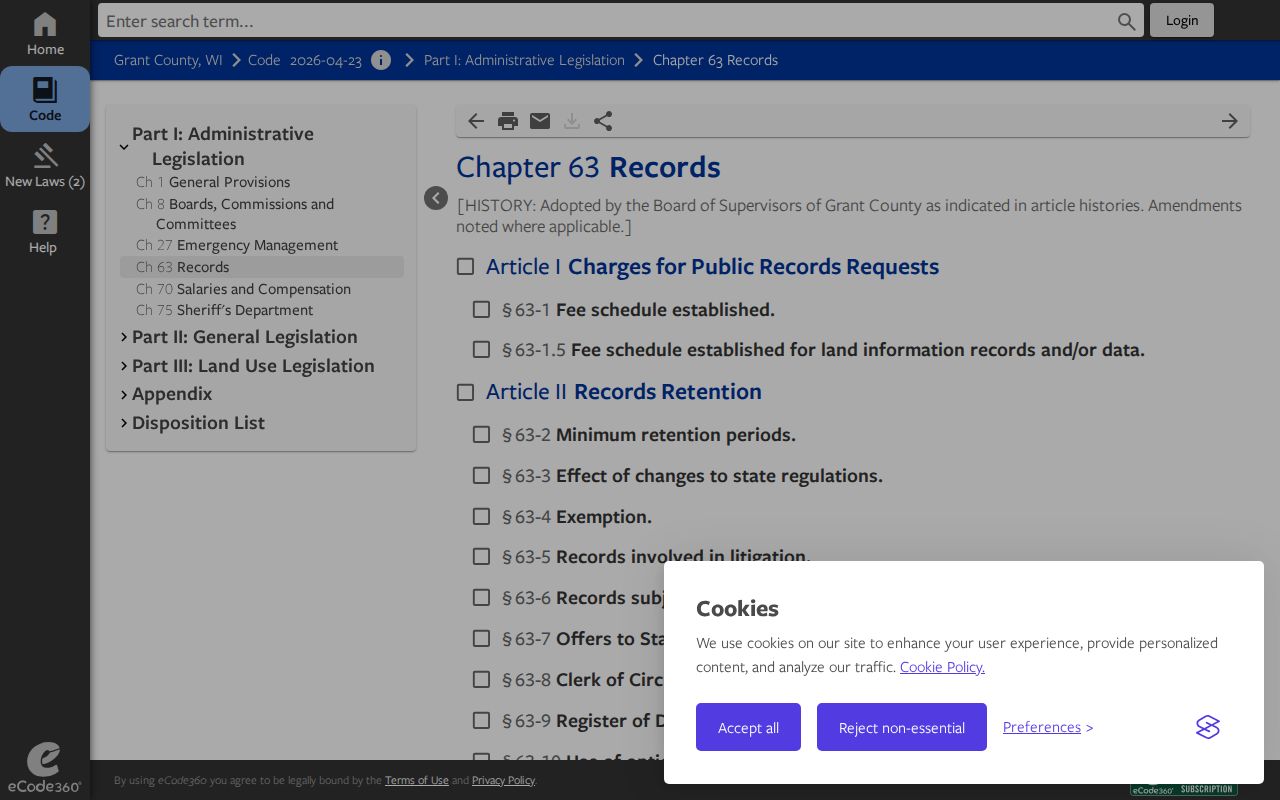
The captured ordinance supports general county fees, not a universal charge for certified circuit copies or transcripts.
Redaction in Grant Court Copies
Public access does not permit release of every field. Filers, clerks, and courts follow Wisconsin rules for protected personal information and confidential documents. A public copy may hide financial identifiers, protected addresses, victim or witness details, or other information barred by statute, rule, or order.
Redaction means protected content is removed or obscured while releasable material remains. Sealing is different. A sealed document or case is restricted by legal authority or court order. Do not treat a missing online document as proof of either process. Ask the clerk whether the item is unavailable online, confidential by category, sealed, or available only through a formal request.
Access Rules for Court Records
Wisconsin law expresses a strong policy favoring access. Wis. Stat. §§ 19.31 and 19.35 provide the general inspection and copying framework. Wisconsin court guidance cites § 59.20(3) for inspection of papers kept by the clerk or register, subject to other law and court rules. Juvenile, sealed, confidential, expunged, and other protected matters may be absent or limited.
A requester should ask the custodian for inspection or copies and describe the record narrowly. The office may redact protected information, apply a statutory exemption, or require a motion or court order. A WCCA result does not waive those limits. If access is denied or delayed, ask for the legal basis and the correct court-specific follow-up route.
Key Rules:
Wis. Stat. § 19.31 states the policy favoring public access.
Wis. Stat. § 19.35 supplies the general inspection and copying right, subject to limits.
Wisconsin confidentiality guidance explains when law, rules, or court orders restrict release.